
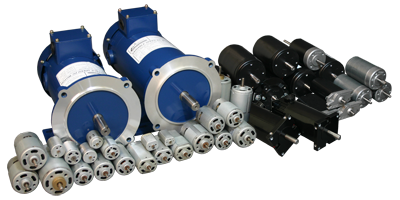
The small Brush DC Motor was designed for high volume OEM applications with low cost being the primary objective. The Small Brush DC Motor comes in sizes from 0.29" to 3.6" diameter. Anaheim Automation also offers a line of quality Permanent Magnet 56C DC Motors available in many different Horsepower levels, ranging from 1/2 all the way to 1 horsepower with various operating voltages. Larger in size, these motors can deliver torque from 288 to 576 oz-in. Custom options include optimizing the maximum speed, torque, current, voltage, cabling, wiring, connectors, and shaft modifications. With our Brush DC Motors you get great quality, great customer service, and competitive prices. Please note that not all small dc motors are stock items, and that minimum purchases will be required for most part numbers listed. However, for most applications, going to another dc motor series, or just a size larger, may provide the solution for your requirements.
|
• Torque: 0.3 to 18.5 Ounce-Inches
• Sizes: From 20mm to 52mm • Cost-Effective Rotary Motion Control • DC Motors are Fully Reversible • Medical, Pump, Semiconductor Applications • Popular for Robotics and Hobbyists • Customization and Motor Adders Available • Designed for High Volume Applications (many items in stock for user customers)
• Torque: 288 to 576 oz-in
• Frame Size: 56C • Speed: 1800 and 2500 RPM • Cost-Effective Rotary Motion Control • DC Motors are Fully Reversible • Totally enclosed fan cooled (TEFC) • Class F Insulation means max temp up to 221° F with full load |
- DC Motors - History
- DC Motors - Basics
- Carbon Brushes
- DC Motors - Types
- DC Motors - Applications
The history of DC Motors can be traced back to the 1830's, when Michael Faraday set to devise an experiment to demonstrate whether or not a current carrying wire produced a circular magnetic field around it. Michael Faraday's experiment turned out to be a success; the current carrying wire did produce a circular magnetic field. While Michael Faraday is often credited for the invention of the electric Motors, his experiment is really just a lab demonstration; as you can't harness it for useful work. Several other scientists such as: Joseph Henry and William Sturgeon based their work on Faraday's experiment and theories and by the late nineteenth century the design of DC Motors had become well established. The demand for DC Motors has skyrocketed since than as a necessity in industrial applications. 