
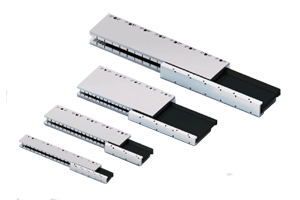
Take advantage of Anaheim Automation's line of Linear Servo. Packed with power, precision, and efficiency, these linear servo motors offer up to 9,700 Watts in a wide variety of sizes. From peak forces of 112N to 3,560N and coil assembly lengths from 84mm to 514mm, Anaheim Automation is sure to have a linear servo motor for your application. The linear servo motors are designed to eliminate backlash, wear, and maintenance issues that come with ball screw, belt, and rack and pinion based positioning systems. Other advantages include high accuracy, faster acceleration, higher velocities, longer life cycles and long term reliability. Anaheim Automation's linear servo motors are suitable for clean room environments offering low noise at high speeds and great performance. They are also a good fit for robots, tables/stages, positioning, actuators, fiberoptics alignment and positioning, electronic manufacturing, machine tools, semiconductor equipment, and many more. Consult with a knowledgeable Anaheim Automation representative today to spec out a Linear Servo Motor that's right for your application.
|
• Up to 224N of Peak Force
• Up to 1,1920 Watts • Overlapping Windings for Shorter Overall Length • Superior Thermal Efficiency • Features I Beam design
• Up to 606N of Peak Force
• Up to 1,814 Watts • Overlapping Windings for Shorter Overall Length • Superior Thermal Efficiency • Features I Beam design
• Up to 1,048N of Peak Force
• Up to 4,147 Watts • Overlapping Windings for Shorter Overall Length • Superior Thermal Efficiency • Features I Beam design
• Up to 3,558N of Peak Force
• Up to 9,677 Watts • Overlapping Windings for Shorter Overall Length • Superior Thermal Efficiency • Features I Beam design |
- Linear Servo Motors - Basics
- Linear Servo Motors - Benefits
- Linear Servo Motors - History
- Linear Servo Motors - Types
Today's Linear Servo applications are more demanding than it has in the past. Higher precision, longer life, almost no maintenance, fewer moving parts, and the list goes on. Linear Servo companies strive to meet these requirements and exceed them by continually creating new technology.
About ten years ago, it was difficult to find commercially available Linear Servo products that could travel 5 meters per second with straightness, load capacity and stiffness. Today there are many Linear Servo products with these characteristics and are fairly cost effective.
Advancements in Linear Servo encoder technology assist in higher speed operation too. Present day Linear Servo encoders and other devices are able to meet this challenge, are less noise susceptible, and cost less. Improvements in Linear Servo, mechanical drives have also moved forward. Ball screw's with higher accuracy and faster lead's result in higher throughput.
The accuracy, resolution and repeatability of a Linear Servo driven device are controlled by feedback. With a wide variety of Linear Servo feedback devices available, resolution and accuracy are primarily limited to a budget and control system.
The response rate of a Linear Servo can be over 100 times greater than a mechanical transmission. This proves to be a faster acceleration and settling times. Because there is no mechanical aspects to the Linear Servo motor, increasing the stiffness is determined by gain and current. The spring rate of a Linear Servo driven system can more efficient than a ball screw driven device. This is limited, however, by the Linear Servo peak force, available current and Linear Servo resolution of the feedback. Because of the present Linear Servo products have no contacting parts, there is no wear.
The Linear Servo has come of age in the past decade, through a dramatic increase in practical and beneficial industrial applications. The Linear Servo motor was invented by Professor Eric Laithwaite, the british Electrical Engineer who died in December 1997 at the age of 76. It projected a shuttle across a weaving look using a Linear Servo. Professor Laithwaite had been amused with the weaving process ever since his childhood living in the UK's textile manufacturer home.
Professor Laithwaite described his invention of Linear Servo as "no more than an ordinary electric motor, spread out". The principle created magnetic fields on which an object rested and travelled without being slowed by friction. Laithewaite pioneered the commercial department of the first Linear Servo application, developing direct linear drives for both machinery and transport.
Linear Servo products have evolved in different guises but the most common is the tubular type, flat of "U" channel type Linear Servo products, which are finding increasing because of their low profile and high powered output. Most linear motors are assumed to use brushless technology.
Cylindrical moving magnet Linear Servo - The coil assembly is cylindrical and travels up and down a cylindrical bar or magnetic way. The Linear Servo products were one of the first to be used in a commercial application. However, they do not share the same characteristics of the flat and U channel Linear Servo.
U Channel Linear Servo - The u channel Linear Servo has two parallel magnet tracks facing each other with the coil assembly between the plates. The coil assembly of the Linear Servo is supported in the magnetic way by a bearing system. The Linear Servo coil assemblies are ironless, showing no attractive force and no disturbance forces generated between coil assembly and magnetic way. The u channel Linear Servo has low mass providing a very high acceleration rate.
Slotless ironless flat Linear Servo - The slotless, ironless flat Linear Servo is a series of coils mounted to an aluminum base. Because of the lack of iron in the coil assembly, the motor has no attractive force or cogging, in which the U-channel Linear Servo has. These Linear Servo products are ideal for smooth velocity control and great for applications requiring scanning. It yields the lowest force output of a flat track Linear Servo design.
Slotless iron flat Linear Servo - The slotless, iron flat Linear Servo is similar to the slotless ironless flat Linear Servo except the coils are mounted to iron laminations and then to the aluminum base. Iron laminations help direct the magnet field and therefore increasing the force. Because of the laminations of iron in the coil assembly, an attractive force is present between the magnetic way and coil assembly of the Linear Servo. As a result, a cogging force is present on the motor.
Slotted iron flat Linear Servo - The slotted iron flat Linear Servo have coil windings that are inserted into a steel structure creating the coil assembly. The iron core's advantage increases the output force allowing the motor's magnetic field being created by the winding. The attractive force of the Linear Servo's iron-core and the magnet track can be used as a preload for an air bearing system. However, the Linear Servo force can cause an increase in the bearing wear. Cogging forces will exist but can be reduced by skewing the magnets of the slotted iron flat Linear Servo.
Linear Servo products offer many advantages over mechanical systems. Some points include high and very low speeds, faster acceleration, and almost no maintenance and little backlash.
